
Grand Canal Capital Partners
Confidential · [AI-DRAFT] · 08 · 2026
Prepared for Collen Investment Group · Credentials and high-level strategic assessment · August 2026

14–17 O'Connell Street Lower

Apart-Hotel Strategy, Operator Selection and Commercial Structure.
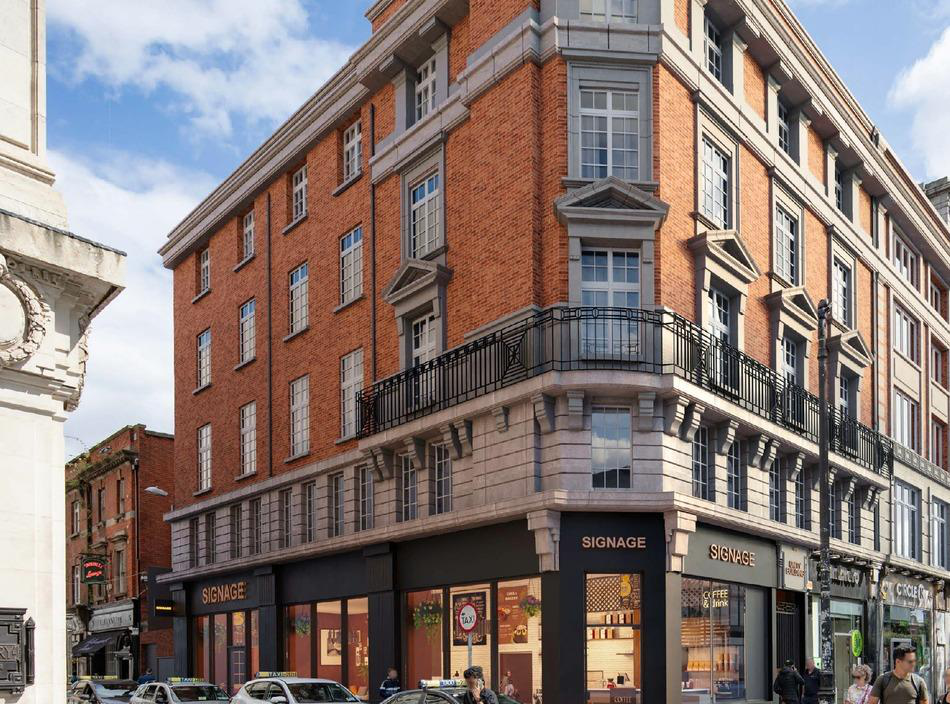
Consented scheme viewed from O'Connell Street Lower. CGI: Digital Dimensions, Visual Assessment Report — View 3 Proposed, October 2025.
Consented keys44 · apart-hotel
FabricFour protected structures
PlanningFinal grant · 24 March 2026
Prepared forCollen Investment Group
StatusSubject to Contract / Contract Denied / Without Prejudice
The brief — 25 August 2026

Your questions, and where we answer them.

Credentials

The firm, and the person leading the work.

Grand Canal Capital Partners originates, structures and executes Irish and UK hotel transactions. We do not operate hotels — our value is in pricing, structuring, and knowing which operator will sign.

Years advising on Irish hotel investment
20+
Chartered valuation credibility
MRICS
and MSCSI — chartered valuation credibility
Director and Senior Director, CBRE Hotels, Dublin
8 yrs
Relevant track record — Dave Murray
Project / assetWhat the mandate involvedClient
Guinness Quarter, St James's GateOperator selection for two hotels — one luxury, one lifestyle upscale — within a 5-hectare urban quarterBallymore, Diageo
Project Connolly, DublinOperator selection of a 240-room hotel in a major mixed-use scheme, let to The Standard Hotel Group under a management agreementBallymore / Oxley
Staycity, Dublin city centreRe-negotiation of a previously signed lease, and acquisition of a 340-key apart-hotelSong Capital
Premier Inn, Dublin DocklandsPre-let of a 263-bedroom hotel to Premier Inn, and the subsequent forward-funding disposalGlenveagh plc
Premier Inn, Newmarket YardsPre-let of a 157-bedroom hotel to Premier Inn, and the subsequent forward-commitment acquisitionBain Capital / Deka
National Sports Campus, DublinMasterplan advice, advisory reports for Government funding, and operator selection for athletes' accommodationSport Ireland
01
Section one

The opportunity

What is consented, and what the location is becoming.

14–17 O'Connell Street Lower, Dublin 1

A consented 44-key apart-hotel on the boulevard.

Planning reference
WEB5551/25 — Dublin City Council
Final grant
24 March 2026 (registered 22 January 2026)
Applicant
D1 Collection Limited
Consent
44-bedroom apart-hotel, first to fourth floors, Nos. 14–17
Ground floor
Change of use of the No. 17 restaurant to reception and coffee shop
Basement
Partial change of use to admin, plant, storage and staff
Enabling works
Party-wall openings at each level to link the four buildings; enlarged universal-access lift at Nos. 16–17
Constraint
Each of the four buildings is a protected structure
Consented apart-hotel keys over four protected structures
44
A second income line worth testing The consent turns the No. 17 restaurant into the apart-hotel reception and coffee shop. An operator may not require that restaurant area within its demise — in which case it could be held back and let separately, producing additional rental income alongside the apart-hotel rent. Worth putting to operators at the sounding stage.
Why the pitch works

The largest regeneration pipeline in the city.

An apart-hotel here is underwritten on the street as it will trade once the following complete — and an operator will price it that way too.

Consented scheme — CGI, View 1 Proposed
Consented scheme — CGI: Digital Dimensions, View 1 Proposed
1

GPO regeneration

€200m–€500m committed under the National Development Plan to reposition the GPO as a civic and cultural destination

2

Dublin Central

5.5 acres with c.200m of O'Connell Street frontage — 40,000 sq m of workspace, two hotels, 100 homes

3

Clerys Quarter

Offices, an 18,000 sq ft rooftop bar and restaurant, two hotels, Earl Place Market, H&M and Decathlon

4

MetroLink

A future O'Connell Street station on the Swords–Airport–city line. The single biggest change to this pitch

5

Dublin Arch

111,000 sq m at Connolly — six office buildings, 187 homes, a 200-bed hotel and a new public square

6

Parnell Square

A 5,500 sq m City Library and conference centre, anchoring the north end of the boulevard

Consented accommodation within a few minutes' walk

Demand validation and competing supply in the same figures — which is why an operator commitment now matters.

229
Room hotel · Earl Place
245
Room hotel · over Arnotts
600
Hostel beds · Sackville Place
316
Student beds · Independent House
02
Section two

The operator selection process

How a competitive process is actually run — and why the sequence matters more than the shortlist.

How we would run it

Four phases, roughly six to eight months.

The apart-hotel operator pool is genuinely limited — but demand within it is strong, and it is a market that rewards a tight, well-targeted approach rather than a wide auction. We would run a target list of 5 to 10 parties.

Phase 1 · 2–3 weeks

Pre-marketing

 
  • Kick-off and site visit
  • Target list and market sounding — 5 to 10 parties
  • Marketing collateral and data room
  • Objective setting and draft heads of terms
Phase 2 · 5–6 weeks

Marketing

 
  • Meetings and calls with each operator
  • Managed site visits and Q&A
  • Challenge operators' trading assumptions
  • Guide offers toward your requirements
  • Collect non-binding offers
Phase 3 · 9–11 weeks

Selection

 
  • Qualitative and quantitative assessment
  • Advise on viability, risk and brand fit
  • Shortlist of no more than three
  • Negotiate; second round of offers
  • Best and final; exclusivity
Phase 4 · 10–12 weeks

Signing

 
  • Coordinate legal advisers
  • Sign off the fit-out and brand plan
  • Agree the specification against the rent
  • Execute the lease or agreement
To your question on sequencing Yes — go to operators before the design and specification are fixed. Room size, kitchenette provision, back-of-house and the FF&E split are what set the rent, and they are the operator's requirements, not yours. Freezing the design first means paying to build something you then discount to let.

Indicative timeline; Phase 2 onward is affected by your own decision process. Figures reflect current market practice for a Dublin operator selection.

Competitive tension

Why the process, and not just a phone call.

You could approach one operator you know and take the terms offered. The reason not to is that operator terms move materially under competition, and the movement is in the owner's favour on every line that matters.

Rent or fee level

The headline number, and the one most owners focus on exclusively.

Guarantee or covenant

Whether the rent is backed by a parent guarantee, a bank guarantee, or nothing at all. Frequently worth more than the headline rent.

FF&E and fit-out split

Who funds the fit-out, at what €/key, and whether it is a contribution or a rent-free equivalent. The largest single swing in your net development cost.

Rent-free and ramp-up

Length of the rent-free period and whether rent steps up over the ramp. Concedes quietly under competition.

Break options and term

Frequency of tenant breaks, compensation on break, and total certain term — which is what drives the investment yield on exit.

Five negotiable terms, of which the rent is only one. A single-operator negotiation typically settles four of them on the operator's standard form.

03
Section three

Lease or management agreement

Two structures, two entirely different risk positions for you as owner.

The choice

Three structures, and what each one hands you.

Lease

You are a landlord
Your income
Contracted rent, fixed or hybrid
Trading risk
Sits with the operator
Upside
Limited — indexation, or a variable top slice
Control
Low — brand standards and use only
You fund
Generally full turnkey; in some cases a partial fit-out
Financing
Straightforward — bankable contracted income

Franchise

You operate under a brand
Your income
Trading profit, less franchise fees
Trading risk
Entirely yours
Upside
Full
Control
High, within brand standards
You fund
Everything, plus working capital
Financing
Hardest — you carry operating risk

Management agreement

You own a trading business
Your income
Gross operating profit, less operator fees
Trading risk
Sits with you
Upside
Full
Control
Moderate — via budget, performance test, approvals
You fund
Fit-out, FF&E reserve, working capital
Financing
Harder — income is not contracted

Terms common to all three: length of term, extension options, brand standards and capex freeze, break options, key money, FF&E reserve, transitional services and any PIP or capex plan.

Structure one

Lease — certainty of income, capped upside.

Where it wins for the owner
  • Contracted income from day one — no trading risk, no employment risk, no opex exposure
  • Financeable — a contracted rent is what a lender will lend against and a valuer can capitalise
  • No owner-side asset management function required
  • Simple governance — you are a landlord, not a hotel owner
Where it costs you
  • You give away the trading upside in a market running at record RevPAR
  • Covenant risk concentrates in one tenant for 25 years
  • A smaller pool of operators offers leases than management agreements — less competitive tension
  • No influence over how the asset is run
Where lease terms sit in the current market
Term25 years typical; 20–35 years all evidenced in Dublin
StructureHybrid fixed-plus-variable now favoured by institutional owners — a lower fixed component, a higher variable share
Break optionMore frequent than historically, with a compensation mechanism
Conversion rightA flip to franchise or management agreement is not standard, but worth exploring depending on your exit strategy

Market-practice summary based on GCCP operator-selection experience and current European lease negotiations. Indicative — actual terms are asset and covenant specific.

Structure two

Management agreement — full upside, full responsibility.

Where it wins for the owner
  • You keep the whole trading upside in a strong market
  • A far larger pool of operators offers management agreements — real competitive tension on terms
  • Owner protections have moved your way: performance tests, cure rights, owner priority return, guarantees, key money
  • Brand distribution and loyalty programme drive the top line
  • Flexibility to reposition, re-brand or convert to franchise or lease to facilitate a sale
Where it costs you
  • Trading risk, employment exposure and working capital all sit with you
  • You need an owner-side asset management capability — a cost a 44-key asset struggles to carry
  • You fund fit-out, FF&E reserve and pre-opening
  • Income is not contracted, so it is harder to fund and typically valued at a wider yield
  • Fee stacks are opaque unless negotiated hard — base, incentive, brand, marketing, loyalty and distribution all land separately
Where management agreement terms sit in the current market
Term20 years typical, plus two five-year renewals; shorter terms are now obtainable
Base feeBroadly 1.5%–3.0% of revenue, with the emphasis shifting toward profit-based incentive fees
Incentive feeBroadly 4%–12% of adjusted gross operating profit, usually banded by margin
Owner protectionOwner priority return with limited clawback and no annual caps; FF&E reserve increasingly notional or capped
Performance testThis provision provides the Owner with the ability to terminate in the instances of under-performance

Market-practice summary based on GCCP operator-selection experience and current European management agreement negotiations. Indicative only.

Which one fits this asset

For a 44-key apart-hotel, our view is a lease.

1

A 44-key asset cannot carry an owner-side operating function

Asset management, financial control, procurement and employment risk cost broadly the same whether the hotel has 44 rooms or 200. On 44 keys that overhead consumes the very upside a management agreement is meant to deliver.

2

The value case rests on capitalising contracted income

All eleven Dublin transactions in Section 4 sold on the strength of an occupational lease, at yields between roughly 4.0% and 5.05%. A 44-key lot is likely too small for the institutional capital behind those deals, so the realistic buyer is a private investor, family office or syndicate — but they will still price off the lease, and there is no comparable market at all for an unleased trading asset of this size.

3

Branded management operators do not take 44 keys

Published site-selection criteria for the major apart-hotel and lifestyle brands start at 60 to 100 units. A management agreement at this scale means a small or white-label operator, which removes the brand distribution that is the main argument for the structure.

4

The apart-hotel model is built for fixed rent

Low fixed staffing, remote check-in and limited food and beverage produce a stable, high-margin operating profit — which is precisely what lets an operator commit to a fixed rent at this scale.

But negotiate the option, not just the rent Explore a conversion right to franchise or management agreement — not standard, but worth testing against your exit strategy — and press for a parent-company guarantee behind the rent. Either is worth more on exit than another €500 per key of headline rent.

GCCP view, on the evidence in this pack and before any operator sounding. A market sounding may change it — that is what the sounding is for.

04
Section four

Market evidence

What Dublin hotels have actually let for, and what those leases have actually sold for.

Lease evidence

Thirteen Dublin hotel and apart-hotel leases.

HotelLocationGradeRoomsAnnual rent (€)Rent / room (€)TermRent review
Ruby MollyDublin 74-star2724,760,00017,50030 yrs5-yearly CPI, cap 4% / collar -1%
Premier Inn NewmarketDublin 83-star1511,623,00010,74825 yrs5-yearly CPI, cap 4% / collar 0%
Premier Inn CastleforbesDocklands3-star2623,013,00011,50025 yrs5-yearly CPI, cap 4% / collar 0%
Premier Inn Gloucester StDublin 23-star1131,412,50012,50025 yrs5-yearly CPI, cap 4% / collar 0%
Staycity Little Mary StreetDublin 8Apart-hotel3404,462,80013,12625 yrs5-yearly CPI, cap 4% / collar 1%
Staycity Townsend StreetDublin 2Apart-hotel2022,440,00012,07925 yrs5-yearly CPI, cap 4% / collar 0.995%
The Samuel HotelDublin 14-star2042,805,00013,75035 yrs5-yearly CPI, cap 3.5% / collar 0.5%
Premier Inn Sth Gt Georges StDublin 23-star1001,225,00012,25025 yrs5-yearly CPI, cap 4% / collar 0%
Staycity Mark StreetDublin 8Apart-hotel1421,600,00011,26825 yrs5-yearly CPI, cap 4% / collar 0.985%
Clayton CharlemontDublin 44-star1872,962,85715,84435 yrs5-yearly CPI, cap 3.5% / collar 0.5%
The MarkerDublin 25-star1874,846,71725,91820 yrsIndex linked
Premier Suites BallsbridgeDublin 4Apart-hotel49950,00019,38735 yrs5-yearly CPI, cap 4% / collar 1%
The GibsonDublin 14-star2524,200,00016,66735 yrs5-yearly CPI, cap 3.5% / collar 0.5%
Average across all thirteen: €14,811 per room. Four-star city-centre median €16,667 · apart-hotel average €13,965. Highlighted: the only sub-100-key comparable in the set.
Rent per room — the read-through

What this evidence says about your 44 keys.

Annual rent per room (€) — thirteen Dublin leases
Highlighted: Premier Suites Ballsbridge (49-key apart-hotel) · Ruby Molly (best recent benchmark)
Source: GCCP · lease evidence, Section 4.

Apart-hotel rents sit below hotel rents per key, but the Staycity evidence is dated

The three Staycity pre-lets were struck between 2015 and 2018 and commenced between 2022 and 2023. They understate today's terms.

Ruby Molly is the best recent benchmark

€17,500 per key on a 30-year lease, executed 2021 for a 2024 commencement, at 272 keys in a comparable city-centre position.

Investment evidence

Eleven Dublin hotel investment transactions since 2017.

Every transaction below was an investment sale subject to an occupational lease. That is the exit this scheme is being built toward.

PropertyLoc.GradeRoomsDatePrice (€)Per room (€)NIYStructureBuyer
Ruby MollyD83-star272Oct-2286,000,000316,1765.05%Fwd purchase, leaseDeka Immobilien
Premier Inn NewmarketD8Budget151Oct-2234,650,000229,4704.26%Fwd purchase, leaseDeka Immobilien
Staycity Little Mary StD7Apart-hotel340Sep-2292,400,000271,7654.40%Lease to StaycitySong / Alpha Real
The Samuel HotelD14-star204Sep-2252,000,000*255,000*4.25%*Lease + ground leaseBlackstone
Premier Inn Gloucester StD2Budget111Jun-2235,000,000315,315Sub-4%Fwd fund, leaseAviva Investors
Staycity Dublin CastleD8Apart-hotel52Jun-2211,500,000221,1544.75%Lease to StaycityBNP Paribas REIM
Premier Inn CastleforbesDocklandsBudget262Jul-2170,000,000267,1764.25%Fwd fund, leaseUnion Investment
Clayton CharlemontD24-star187Apr-2065,000,000347,5944.25%Sale and leasebackDeka Immobilien
Premier Suites BallsbridgeD4Apart-hotel49Sep-1817,500,000357,1435.00%Sale and leasebackAviva Investors
The GibsonD14-star252Dec-1791,200,000361,9054.29%Lease to DalataDeka Immobilien
Maldron SmithfieldD73-star92Feb-1720,000,000217,3915.02%Lease to DalataDeka Immobilien
Highlighted: the two sub-60-key transactions. Small lots traded at 4.75%–5.00% — roughly 50 to 75 basis points wider than the large-lot institutional set, but they traded, and to institutional buyers. * Estimated.
The read-through

Does the rental and investment value justify the build?

A first-order test, not a valuation. It tells you whether Plan 2 is worth the next stage of work — not what the asset is worth.
A · Indicative rent
€18,000 – €23,000
per key, per annum
B · Passing rent on 44 keys
€792k – €1.01m
per annum, fixed
What we cannot yet answer The delivered development cost — fit-out and FF&E per key across four linked protected structures, plus the ground and basement income you would displace. Until an operator sets the specification that number cannot be fixed. Plan 2 works if all-in cost lands comfortably below column C.

GCCP indicative analysis derived from the evidence in this pack. Not a valuation, not advice to transact, and subject to specification, covenant, term and letting risk.

Operator demand

44 keys rules out a hotel, not an apart-hotel.

Why a traditional hotel does not work here
  • A conventional hotel has to provide food and beverage, a staffed reception, housekeeping, back-of-house and a full management structure
  • Those costs are largely fixed, so they need volume to carry them — which is why branded hotel operators set minimum key counts
  • At 44 keys the overhead per key is simply too high for that model to pay
Why the apart-hotel model does
  • An apart-hotel carries none of those obligations — no food and beverage requirement and no full-service ancillary offer
  • In-room kitchenettes let the guest self-serve; check-in is lobby-based or remote, staffing is low and fixed, stays are longer and servicing less frequent
  • So critical mass is reached at a far smaller lot size — which is precisely why this is the consented use, and why the 44 keys is not the obstacle it first appears
What scale does still affect

The size of the tenant pool

Every additional key widens the field of operators who will look at it. At 44 the pool is real but narrow; at 80 to 120 it is genuinely competitive.

What that pool will pay

More bidders is what moves rent, covenant strength and the fit-out contribution — not the building, and not the location.

Liquidity on exit

A €14m–€19m lot sells to private investors and family offices. North of €30m opens the buyer universe considerably.

The option your portfolio creates You own roughly ten adjoining buildings. Combining 14–17 with adjacent upper floors to reach 80 to 120 keys is a pricing and liquidity decision, not a viability one — the 44-key scheme works on its own.

A named target list is the first deliverable of Phase 1 and follows a market sounding, not a desk view.

Next steps

How we would progress it from here.

A staged appointment, so you can stop after Stage 1 if the answer is no.

Stage 1 · 2–3 weeks

Strategic assessment and market sounding

 
  • Confirm the consented scheme, key mix and net saleable area against the operator specification
  • Discreet, no-names sounding of 5 to 10 operators on appetite, structure and indicative rent
  • Test the 44-key case against an enlarged 80 to 120-key case using adjoining buildings
  • Written recommendation: proceed, enlarge, or stop
Stage 2 · 5–6 months

Operator selection process

 
  • Full competitive process as set out in Section 2 — marketing, offers, shortlist, negotiation
  • Specification and fit-out cost set by the winning operator's requirements, not before
  • Like-for-like comparison of every offer on a net effective basis
  • Heads of terms agreed under exclusivity
Stage 3 · 3–4 months

Documentation and delivery

 
  • Coordinate legal advisers to lease or agreement for lease
  • Sign off the brand and fit-out plan against the agreed rent
  • Ongoing input through construction and hand-over
  • If an investment sale is the exit, take the leased asset to the institutional market

Timings indicative and dependent on your own decision process. Fee proposal below.

Commercial terms

Fee proposal.

Staged and success-based, against the stages set out above. No marketing cost, and we are paid when an operator signs.

ServiceScopeFee
Operator selectionFull competitive process: marketing, offers, shortlist, negotiation and heads of terms under exclusivity10% of the average annual rent achieved over the first five years of the term, ignoring any rent-free period or inducement. Payable on signing of the lease agreement.
Investment sale — optionalTaking the completed, income-producing investment to market1% of the gross sale proceeds. Payable on completion of the sale.

No marketing cost

We carry the cost of the marketing collateral, the data room and running the process. No marketing budget is sought from you.

Instructed stage by stage

Each stage is appointed separately. You are under no obligation to proceed beyond the stage in front of you, and nothing falls due for a stage you do not instruct.

VAT and outlay

All fees exclusive of VAT. Third-party outlay — legal, technical, planning — contracted by you directly.

Indicative terms only. Not an offer capable of acceptance; a formal engagement letter would follow agreement of scope and terms.

In summary

Consented. Evidenced. Ready to sound the market.

Planning on a protected structure is the hardest consent to win on this street, and it is granted and final. The open questions are commercial, not planning — who operates it, on what structure, and at what rent. That is the work in front of you, and it is the work we do.
Grand Canal Capital Partners
Contact · GCCP partners
Dave Murray
Partner
dave@gccapitalpartners.ie
Aaron Sherlock
Partner
aaron@gccapitalpartners.ie
Jonathan Hillyer
Partner
jonathan@gccapitalpartners.ie
Christopher Belton
Partner
chris@gccapitalpartners.ie
Office
10 Duke Street
Dublin 2 · D02 AD78
Ireland
Web
www.gccapitalpartners.ie
Grand Canal Capital Partners | Confidential Subject to Contract / Contract Denied / Without Prejudice August 2026